

King Global Critical Minerals Reports Gold And Silver Results From Systematic Sampling Of Golden Turkey Tailings Arizona

King Global Critical Minerals (CSE:KING)
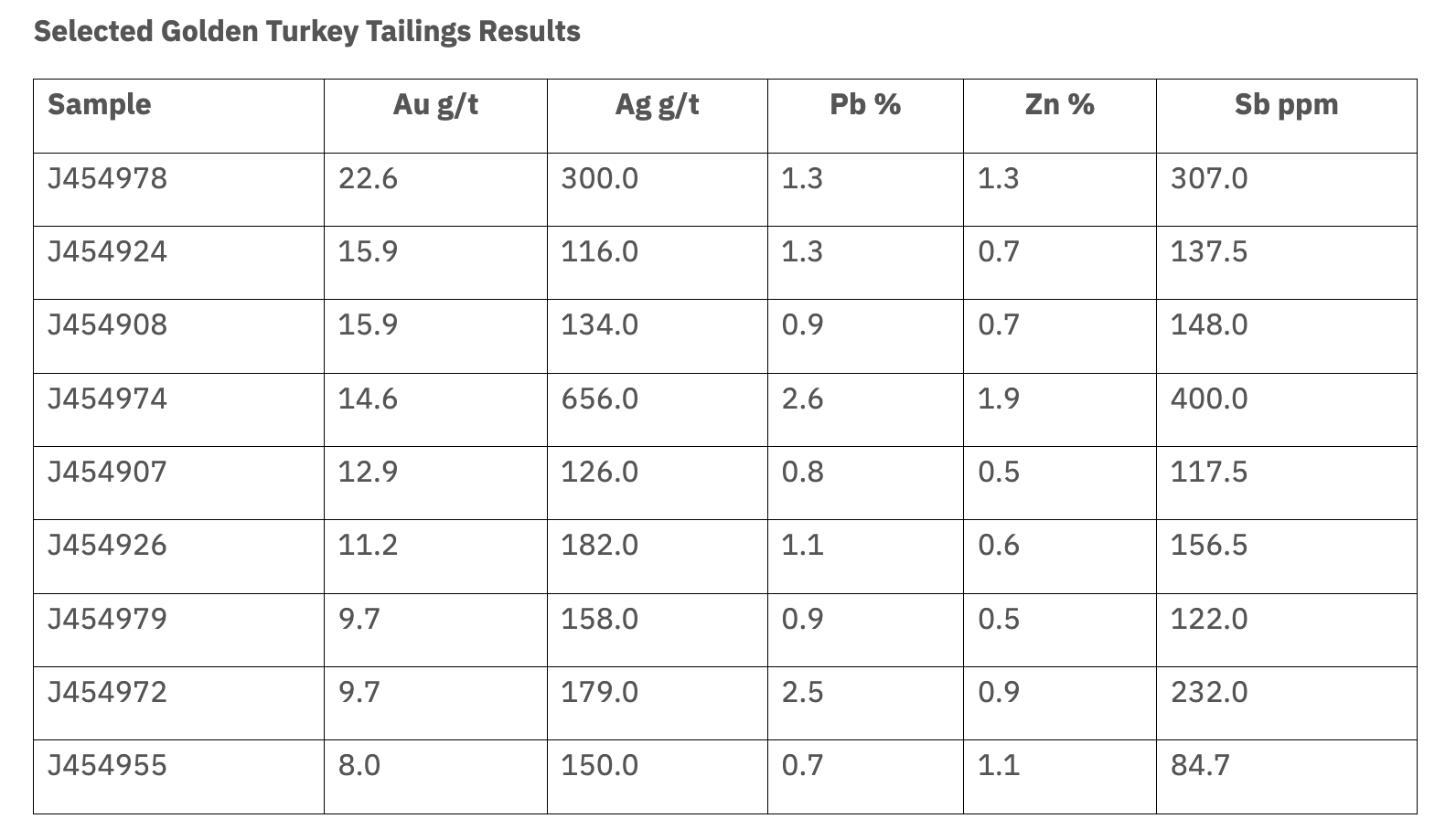
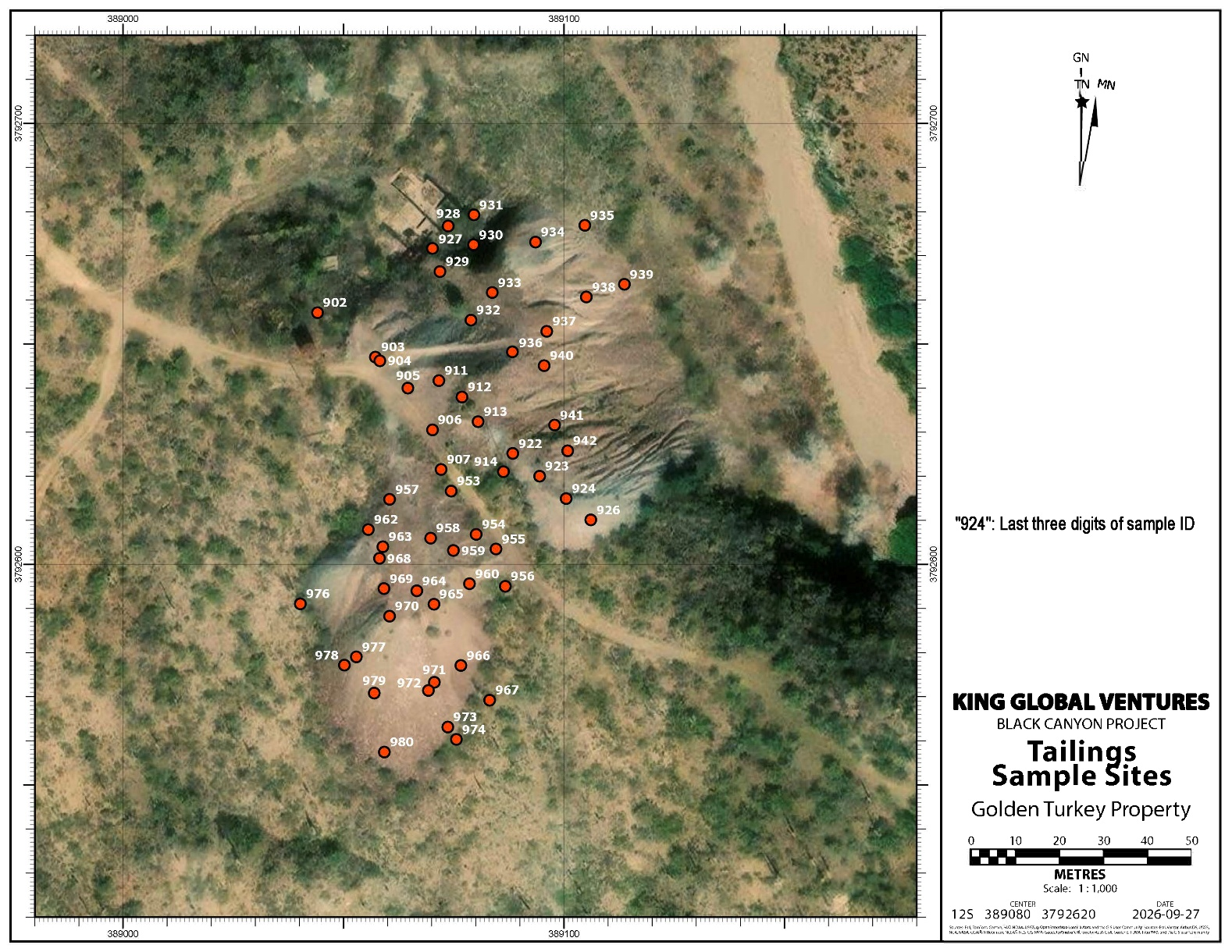
VANCOUVER, BC, CANADA, September 29, 2026 /EINPresswire.com/ -- The 2026 program was designed to characterize the lateral distribution of precious and base metals across the exposed near-surface portion of the historic tailings and builds upon an earlier sampling program completed in April 2024 under the supervision of the Company's independent Qualified Person ("QP").A total of 76 tailings samples were collected on an approximately 30-foot grid. The samples returned arithmetic averages of approximately 3.85 g/t gold ("Au") and 76.2 g/t silver ("Ag"), with individual results ranging from 0.08 to 22.6 g/t Au and 6 to 601 g/t Ag. The samples also returned average concentrations of approximately 0.44% lead ("Pb") and 0.42% zinc ("Zn").
Of the samples, 17 returned greater than 5 g/t Au, including six samples exceeding 10 g/t Au.
Sample J454978 returned the highest gold value of the current program at 22.6 g/t Au, together with 254 g/t Ag, 1.14% Pb and 1.12% Zn. Sample J454974 returned 14.6 g/t Au, 601 g/t Ag, 2.33% Pb, 1.67% Zn and 400 ppm Sb, illustrating the polymetallic character of portions of the sampled near-surface tailings.
The reported averages are arithmetic averages of the 76 near-surface samples and characterize only the sampled population. They should not be interpreted as the average grade of the entire Golden Turkey tailings deposit and should not be combined with the historical estimate of tailings quantity to calculate contained metal.
Sampling Method, CIM Leading-Practice Considerations and Representativeness
The sampling program was planned and supervised by the QP using principles consistent with the CIM Mineral Exploration Best Practice Guidelines: the sampling method was selected for the stated objective, sample locations were systematically distributed, collection procedures were applied consistently, and the limitations on representativeness are disclosed. CIM guidance emphasizes scientifically established sampling practices designed to produce representative and reliable results, appropriate sample preparation and analysis, sample security and documented QA/QC.
Samples were collected systematically across the exposed Golden Turkey tailings on an approximately 30-foot grid. At each location, the sampler manually broke and loosened the locally hard and cemented tailings using a hand pick and collected the resulting material with a scoop. The samples therefore represent the near-surface tailings at the sampled locations. They were not vertical channels, auger holes or other continuous samples through the tailings profile, and no continuous sampling thickness is assigned to the reported results.
For historic tailings, mine dumps and similar previously mined material, the QP considers representative spatial coverage, recognition of material heterogeneity, verification of the underlying surface and pile geometry, and representative bulk-density measurements to be important before grade and tonnage can be evaluated together. CIM estimation guidance for stockpiled material similarly recognizes the importance of surveying tonnage, sampling to estimate grade, determining density and having adequate original-ground-surface information for volume estimation.
The Golden Turkey tailings have been exposed for many decades in the arid to semi-arid climate of central Arizona. Prolonged oxidation, episodic precipitation, evaporation and repeated wetting and drying can contribute to development of a hardened or cemented near-surface horizon and may redistribute certain soluble metals and secondary minerals. King has not established that such redistribution has occurred at Golden Turkey or whether the sampled near-surface material is enriched or depleted relative to material at depth.
Accordingly, the current results are considered suitable for characterizing the lateral distribution of metals within the sampled near surface tailings but are not considered sufficient to establish representative grades through the complete vertical profile. Additional vertical sampling, together with representative bulk-density measurements, will be required to determine whether the near-surface results are representative of the tailings at depth.
April 2024 Golden Turkey Sampling Program
The current program builds upon an earlier Golden Turkey tailings sampling program completed in April 2024 under the supervision of Andrew Lee Smith, B.Sc., P.Geo., ICD.D., the Company's independent QP and consulting geologist. The April 2024 program comprised 37 near-surface samples collected using substantially the same manual sampling methodology as the 2026 program. The April 2024 analytical results were not previously publicly disclosed.
The 37 samples returned arithmetic averages of approximately 3.0 g/t Au and 32 g/t Ag. Both the April 2024 and 2026 programs therefore identified gold and silver within sampled near-surface portions of the Golden Turkey tailings. Neither program provides continuous vertical sampling through the tailings profile.
Differences between the arithmetic averages of the two programs may reflect spatial variability, sample locations, analytical procedures, material heterogeneity or other factors and should not be interpreted as demonstrating an increase or decrease in the overall grade of the Golden Turkey tailings. The programs are considered separate sampling campaigns that demonstrate the presence and lateral variability of gold and silver within the sampled near-surface material.
1996 Certified Survey of the Golden Turkey Tailings
King has obtained a historical survey entitled "Estimated Volume of Golden Turkey Tailings," completed in December 1996 by Leslie D. Irwin, an Arizona Registered Land Surveyor. The survey was undertaken to estimate the physical quantity of tailings present at Golden Turkey and included surveyed two-foot contours across the tailings pile.
The survey documentation states that a test well was drilled to a minimum depth of 50 feet before encountering a rock formation interpreted at the time as the original pit bottom. The survey further assumed that the original ground surface on the north side of the tailings pile had an approximate 3:1 slope and that the original pit extended from approximately Elevation 3086 to Elevation 3080. To accommodate uncertainty associated with the average end area of the pile, the calculation applied a 10% reduction to the calculated volume above Elevation 3086.
Click HERE to see full press release
Robert Dzisiak
King Global Critical Minerals
+1 204-955-4803
ir@kingcse.com
Legal Disclaimer:
EIN Presswire provides this news content "as is" without warranty of any kind. We do not accept any responsibility or liability for the accuracy, content, images, videos, licenses, completeness, legality, or reliability of the information contained in this article. If you have any complaints or copyright issues related to this article, kindly contact the author above.
